Depending on when it was built, when someone says ‘mobile home’, that could mean an actual mobile home or what’s now called a manufactured home, and there are differences. For the sake of simplicity, American mobile homes were made before about 1976, and were not subject to the same regulations as the manufactured homes that came after that. It should be noted, however, that the federal code regulating manufactured home construction has been updated from time to time, and in general, the newer the home, the more strictly its original construction was regulated. A home from 1980 might not have ever been of sufficient quality to pass a new home inspection in 2010. But for the purposes of this entry, that doesn’t matter, because we’re talking about mobile homes — the old, crappy ones.
I’ve done a lot of remodeling on older mobile homes, and the thing that stands out most about them is that they’re complete and utter pieces of shit. Seriously. They are so badly made that, as alluded to above, they were eventually outlawed; that prevented companies from making more of them, but it didn’t stop the ones already in existence from being sold, and there are more of them out there than you can imagine. A few of the issues these things have:
•They’re made with cheap materials and scrap. The studs in a mobile home wall are an inch narrower than a standard 2×4, if you’re lucky. Non-load-bearing walls often have 1×3 studs, which is unthinkable to a contractor these days. If you’re wondering about what a pain it was to screw drywall to a 1×3, don’t worry — mobile homes used lightweight, wood paneling instead, which was stapled to the walls. Floor joists were undersized, too, but the really special part of an old mobile home is its roof trusses, which are made of 1x2s, stapled together and braced with scraps of leftover wood paneling. The first time you go on the roof to repair a leak, you’re likely to break a truss, or at least weaken the joints and create future structural problems.
•Speaking of leaks, yeah — they leak. A mobile home roof is covered in strips of metal sheeting that are seamed together, and those seams leak eventually. They also leak at the junction between the roofing material and the metal siding, and they leak wherever there are roof penetrations, because the boots the manufacturers used for things like vents and sewer stacks were cheap as hell, and they broke down in sunlight. Because of the way they’re designed, with nearly-flat roofs, it can also be difficult to find the source of a leak, because water can travel horizontally, ten or twenty feet, before it starts dripping through the ceiling. Imagine all that water soaking into those cheap building materials — during remodels, I’ve found load-bearing structural elements of mobile homes completely decomposed into soil. I’m not exaggerating — I’ve bought potting soil that didn’t look or smell as nice as this stuff. And when there’s a leak in the roof, and the trusses start to decompose, the roof turns from that gentle arch shape we’re all familiar with to a rooftop pool, only no one wants to go to that pool party.
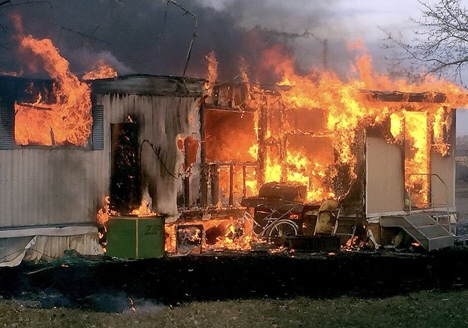
•They also burn. In the tiny town where I live now, we seem to have at least one mobile home fire every year, and when they burn, they burn down to the steel chassis. Despite leaking like sieves, mobile homes are full of fire hazards, owing mainly to three issues — the wood paneling that covers every wall and is inside the ceiling, the generous use of plastic sheeting in the construction process, and substandard electrical work. First, the paneling: if you’ve never burned it before, try it sometime. Wood paneling is made from sheets of thin veneer, coated in glue and pressed together, similar to plywood, then given a treatment on one side that might be just a coat of varnish, or a faux woodgrain pattern painted on or applied in the form of something like a giant decal. Regardless of the exact process, what you end up with is a product where the wood is the least flammable ingredient. Next, the plastic sheeting: because they were cheap, mobile home manufacturers used plastic sheeting in a lot of places where it simply doesn’t belong, and if you’re wondering what some of those places are, it’s anywhere other than on the ground, beneath the home. Plastic sheeting was often used in place of breathable moisture barriers, to create a home that not only traps water and blocks air circulation, but burns like it was doused in gasoline. I’ve found plastic sheeting in mobile home ceilings, walls, and floors. I always rip it out when I find it, but the only way to get it all is to either rebuild the entire home or light it on fire. Which brings me to the electrical systems. I won’t get too into the details, but the basics are that you have wiring that’s too thin, with too many lights and outlets on the same circuit, cheap materials that are more prone to heating up, and dangerous electrical connections. One common problem occurs in old mobile homes with aluminum wiring; aluminum expands more than copper when it gets hot, causing it to loosen connections. It’s more prone to corrosion, and when connected to copper, it corrodes even faster. Some mobile home fires are started when a new light fixture with copper wiring is connected to the old aluminum. Braided aluminum furnace wire is another issue I’ve fought with — braided wire tends to shift its position within connectors even more than solid aluminum wire. I could go on, but instead I’ll just say this: picture a mobile home where you have dried out sawdust and broken pieces of wood, plastic sheeting, and a modern light fixture with three 100W bulbs in it, where it should only have 50s, connected to the home’s original aluminum wiring, all within inches of each other. Now tell me how every old mobile home in America hasn’t burned down already.
•The manufacturing process was also screwed up. Mobile homes weren’t built like a regular house. When I build a standard, ‘stick-built’ house, I start at the bottom and work my way up, essentially building a skeleton. Then I cover it with things like sheathing, moisture barriers, siding, roofing materials (‘skin’) and I install plumbing, wiring, doors, windows, etc. (‘organs’). A mobile home, in contrast, was built in a factory, where each part of the structure — floor, ceiling, walls — was built separately, often in a large jig, and then it was all slapped together. Where I’ve found the biggest problems with this is in the junction between the wall and the ceiling, because the ceiling is fully constructed before it’s set down on top of the walls, and there’s a layer of a fibrous, spongy, ceiling material between the structural members of each component. If you wanted to fasten two pieces of wood together and have them hold as tightly as possible, you would fasten them directly to each other, not put a piece of sponge between them, right? Mobile home manufacturers got around this by using all kinds of metal straps and brackets and things, but the end result is the same — the structure gets loose over time because there’s a soft material in there that tends to soak up water, swell, and rot. And then there’s the biggest problem of all, when it comes to mobile homes …
•The people selling them are scumbags. OK, OK, #notallscumbags sell mobile homes. Or not everyone who sells mobile homes is a scumbag… yeah, that makes more sense… but I think we can agree that certain types of businesses tend to be more attractive to shady assholes than others, and that includes some of the most common proprietors of mobile homes for sale, the owners of mobile home parks. I could go on at great length about these people and all the ways they find to rip people off and take advantage of them, or even the legal action I’ve personally taken against some of them, but I’m focusing on the homes themselves, so I’ll just say that as bad a product as the mobile home was when it was first built, it’s likely much, much worse now, after decades of substandard, often illegal modifications and repairs, in which park owners looking to offload older homes are some of the worst perpetrators. Many are loathe to hire qualified professionals and opt to do the work themselves, or contract it out to the cheapest guy they can find. This has some very scary results. When I’ve been hired to work on these homes, I’ve often found myself in a battle of wills with the park owner, who wants me to cut corners, which I simply will not do. What comes next? I either get fired before the job is done or I have to put a lien on some asshole’s trailer park so I can get paid. (And if you’re a cheapskate slum lord I’ll lien you for a dollar and add on the filing fees; I’m petty that way.)
So as you can see, I don’t have much to say about mobile homes.
Obviously I don’t consider old mobile homes a viable option for any purpose unless you simply have no other choice. The one positive thing I can say about them is that they’re often given away for free, or for a few hundred bucks, because they’re so shitty. If you’re willing and able to essentially rebuild the entire house on the existing steel chassis, which is the one part of the home that’s probably in perfectly good shape, you might have a hell of deal on your hands, with the exception of the cost to move the home, which I’ll talk about in the next section.
I’m not going to score mobile homes on the listed criteria, since they’re not in contention anyway. I’ll just give them a total score of 21, with price being the leading factor.
Biggest pro: They’re often free or very cheap
Biggest con: Terrible quality
Most unique feature: Their ability to be soggy and highly flammable at the same time
 year 45