I may hate old mobile homes, but newer manufactured homes have a lot going for them. They’re better made, using better materials. They look better; in fact, many are indistinguishable from site-built homes, and if you remove the wheels and the tongue and bolt them to a foundation, they appreciate in value just like any other house. One of the biggest benefits of manufactured homes is their size; you can go big. In fact, there are triple-wides with 3,400 square foot floor plans — that’s about the size of my current workshop and barn. Of course, you don’t have to go that big.
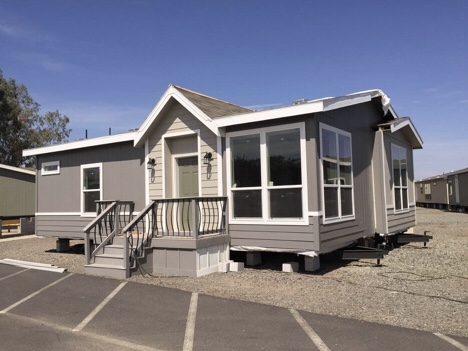
•Portability: Manufactured homes are certainly portable, but they’re very heavy and they’re usually wider than the legal limit for highway travel; that means professional drivers with specialized equipment, oversize load permits, and pilot cars. And money. A local move for a standard single-wide may run you about $3,500; for a double-wide, double that. The good news is I have the license to haul these homes; the bad news is I don’t have the equipment — a toter truck. Toters (not otters, as my iPad keeps trying to correct it to, over and over again, no matter how many times I type it) are semi trucks that are very short in the back end and have an adjustable hydraulic trailer hitch and a rack that carries a bunch of spare tires. Mobile home tires are not like the ones on your car; they’re meant to be single-use, and blowouts are fairly common. Despite the expense, you can still get a manufactured home to most locations in the US and Canada, and they seem to be gaining some popularity in Mexico, but taking one down the road and putting one on a ship are two different things. The dimensions of these homes makes them a poor choice for international shipping. I’m not saying you can’t put one on a ship, but I am saying you can’t do it affordably. In most cases you could build the equivalent site-built home at your destination for less money. Most of the time, these homes are moved twice in their lives: Once from the factory to the dealership, and once from the dealership to the buyer’s property or trailer park, where the tongues and axles or tires are usually removed. Portability score: 2
•Ease of setup: A single-wide is fairly easy to set up, and one person can do it alone with a water level and a good bottle jack. Level the home, hook up water, electric, and sewer, skirt it, and build some steps so you can get in and out of it. For a double or triple-wide, you need a little more equipment to get each section of the home butted up tightly to the next one, and there is a bit more work to do once the sections are in place. The sections have to be connected together, siding and roofing have to be completed at the seams, and there are additional electrical and plumbing connections to be made. For a DIYer, this might take more than an afternoon to complete. Another setup issue to consider is the type of dirt the home will be sitting on; most soils move a bit over time, but some soils move more than others. Expansive soils — usually high-clay soils that shrink and expand depending on moisture content — are especially problematic. A substrate of compacted gravel is a good idea for any manufactured home, but for especially tricky soils it may be necessary to do some concrete work ahead of time. Setup score: 3
•Quality of materials: I mentioned this in the intro, but the quality of materials used in manufactured homes tends to be quite good, and similar to a typical site-built home. You won’t find anything especially cutting edge or exotic in these homes, but they tend to be solidly built. Materials score: 3
•Use of space: Since they come in lots of sizes, the main limitation you’re going to find with manufactured homes is that they’re single-story and they have low ceilings. Since homes generally have to be under fourteen feet tall when they’re being transported, you aren’t going to get a cathedral ceiling, but that’s the case with most of the home types I’m discussing here. It is possible to place a manufactured home above a basement and build a stairway, but that takes considerable modification that probably includes welding. Space score: 4
•Suitability to the climate: While I wouldn’t say a manufactured home is the best option for hot, humid weather, it’s as good as most of the other choices here. The key is maintenance, and not letting problems fester. To deal with the heat, you can get one with air conditioning, or install mini split systems throughout the home. Climate score: 3
•Pest resistance: A manufactured home has the same pest resistance as a typical site-built home, with its main susceptibility being its wood construction, which allows rodents to chew their way inside. The plywood floor of the home makes for easy infiltration. Still, there’s nothing that makes these homes uniquely susceptible to pests, unlike a few other homes I’ll discuss later. Termites are also an issue, due to the wood construction, thus it might be necessary to set some bug bombs now and again. Not something I relish. Pest score: 3
•Style: Manufactured homes tend to look pretty similar to each other, with the exception of the ones that look like cabins. But they do come with many, many color options, so most people can find something that doesn’t offend their delicate sensibilities. Style score: 4
•Sustainability: This one depends a bit on whether the home is new or used; I would score a new manufactured home very low, but since I’m not likely to buy a new one, I’ll focus on used homes, which are, by definition, made of 100% reused materials, unless you find yourself having to make repairs and upgrades. The drawback, in terms of sustainability, is in energy use, as these homes are larger and tend to take more to heat or cool, and the style of construction used is not exceptional in terms of energy efficiency. Sustainability score: 3
•Price: This is probably what manufactured homes have most in their favor, because while a brand new one can cost every bit as much as building your house, unless they’re permanently affixed to your property, they depreciate just like a car does, so used homes can be very cheap, even when they have very little wrong with them. I’ve seen perfectly habitable double-wides for $10,000, and they can be financed. Price score: 5
Total score: 30
Biggest pro: They’re basically just regular, full-size houses
Biggest con: Less portable than advertised
Most unique feature: Their lack of uniqueness, I guess?
 year 45