I live in a travel trailer. I hate it. RVs are terrible. If you’re traveling full-time, but you don’t want to go farther south than Mexico, an RV might be an OK choice for you, but in general, they’re garbage, and a lousy option for long-term housing. They’re poorly built — even the expensive ones. One minor bump and your roof leaks forever. Even with slide-outs, your floor plan options are extremely limited. The kitchens and bathrooms are horrible — I don’t even use mine. And you’re hauling around a tank full of your own shit, and maybe other people’s shit, and that’s disgusting. Try taking a long, hot shower in an RV, I dare you. Try having some friends over. It’s just not a functional home.
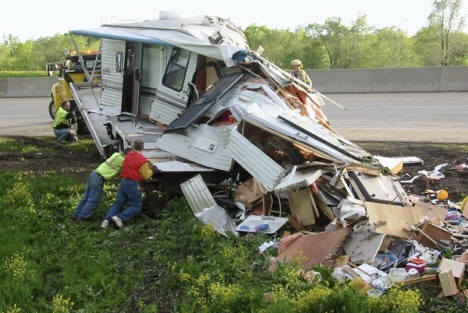
My other big beef with RVs is that most of the people who travel with them have no business moving large vehicles. Imagine being 65 or 70, your vision blurring a little, your hearing going, your reaction time and stamina fading by the day, and thinking, ‘Now would be a good time for me to start driving around a 20-ton vehicle for which I have no training or experience.’ When you add to that the fact that you can drive an economical car and stay in motels for less money than it costs to go by RV, I’m not sure how people justify it.
•Portability: Yes, RVs are very portable, because they’re vehicles. Even though most people shouldn’t be transporting them, they’re legally allowed to, and you don’t need much in the way of special equipment; for a motorhome you don’t need any. An RV can be shipped abroad on a RoRo (google it), which is a pretty cost-effective way to get a fully self-contained home to your destination, even if that home is a piece of shit. Portability score: 4
•Ease of setup: Park it, unhook it from your tow vehicle if applicable, hook it up to electric, water, and sewer, if you want, or not. Level it if you feel like you need to. Extend the slide-outs and awnings if you have them. Retired people with no skills or relevant experience do this every day, and most of the time they even remember to retract the slide-outs and steps before they get back on the road. Setup score: 5
•Quality of materials: Crap. You can get plenty of high end ‘stuff’ inside your RV, but in terms of the structure, it’s going to be garbage. Flimsy 1×2 framing, paper-thin metal skin, plywood subfloor with a fabric moisture barrier that’s virtually guaranteed to take damage on the road or from animals. No amount of oak cabinetry and granite countertops will make this thing well-built. I do have to admit that a few companies have made improvements in this area, but the problem is that it’s very hard to make a wall thin, lightweight, attractive and homey, but also strong and well-insulated. Materials score: 2
•Use of space: An RV is a vehicle, and vehicles have to be 8.5 wide or narrower. Even with the widest slide-outs on the market you’re only adding a few feet. Your height is limited to 14 feet, but in practice you’re going to have much less, unless you’re in a bus conversion or a semi trailer. (More on those later.) Most RVs are well under 40 feet long, although some are considerably longer. Even so, you’re limited by size. Outdoor kitchens help a little. And some models even have fold-down decks, which, as decks go, are kind of -meh-. Space score: 2
•Suitability to the climate: They have heaters and air conditioners that seem to work just fine as long as you have the right power supply. R-values are poor and you get a lot of drafts in older RVs. An RV is as suited to one climate or another the the same extent that a car is; they do OK, but it’s not a major consideration in their design. Of course, if you’ve ever hit a low tree limb or backed into a post or something, you’ve done permanent structural damage that will get worse over time and let an ever-growing quantity of outside weather inside the ’home.’ Climate score: 2
•Pest resistance: Rats and mice have so many ways to get into an RV, you’d think it was made for them. I have to keep a dog in mine at night to keep the rats out. If they can’t find an existing opening, of which there are plenty, they simply chew through the floor. Slide-outs provide another easy way in, but what make RVs the ultimate targets for rodents is their ‘storage’ areas — the places where things like water and sewer tanks, and heating and electrical fixtures are hidden from view. Those areas are hard to get to for you and me, but not so much for a rat. I’ve found nests in all those hiding places, and I’m sure there are others in areas I’ll never be able to see. Pest score: 1
•Style: Vintage Airstreams are cool. Almost no other RV is, and that includes those new RVs that are made to look vintage. They’re ugly, lumbering, stupid-looking things that look white trash no matter how much you pay for them. The graphics manufacturers put on them only make them worse. The idea that someone actually designs all those stripes and swooshes makes me borderline depressed. The interiors can be very, very nice, but that’s not anything unique to RVs, so no points for that. Style score: 1 (unless it’s a vintage Airstream)
•Sustainability: Unless you opt for an RV that’s specifically made from sustainable materials, they’re an environmental disaster. Buying a used one is technically more eco-friendly, but you’re probably just giving someone money to spend on a brand new replacement. Sustainability score: 1 (Because I can’t give a zero. I mean, I guess I could — it’s my scoring system.)
•Price: I’ll split the difference here. The price range on RVs is huge, with rotted out shitboxes being given away for free and luxury bus conversions and trailers going for over a million bucks. There’s an RV for every budget, and for every budget, there’s something else that’s better than an RV. Price score: 3
Total score: 21
Biggest pro: It doesn’t get more portable than this.
Biggest con: Cheap construction
Most unique feature: A big tank of human waste that you get to take with you wherever you go
As you can see, I hate RVs, with some notable exceptions. If you’re camping, I don’t have many bad things to say about teardrop trailers or pop-up tent trailers, but they’re not solutions for long-term housing. I like vintage Airstream trailers because they’re cool-looking, but not for their practicality; if I set one up to live in, I’d take the axles and tongue off and mount it to a foundation, build an exterior kitchen and bathroom and only have a bedroom, dining table, and office space inside. For a more typical RV experience, I much prefer a horse or livestock trailer with living quarters, because those trailers have heavy duty floorboards and sturdier steel or aluminum walls — less leaking, less rodent damage. I would be more likely to live in a bus conversion than a typical motorhome, because the bus was better built to begin with, and as I understand it most buses have a metal floor that helps keep the rats out, though they can still get in through the ventilation systems. Finally, a converted semi trailer, whether you go with a million-dollar custom job or you buy a $3,000 trailer and do it yourself, if well constructed, can alleviate a lot of the problems posed by more standard RVs, though it creates the new problem of being very large and needing a semi truck and a class-A driver to haul it. I have the license, but no truck at the moment. And if I had a truck with a sleeper cab, I’d probably just live in that; I’ve done it before and it’s not too bad.
 year 45