A park model is an RV crossed with a manufactured home, or to put it another way, it’s a small, manufactured home that’s licensed as an RV and can be towed with a pickup. It’s a lot like a tiny house on wheels, except it’s a bit bigger than tiny, and you don’t have to climb into a loft to sleep at night. Park models come in a lot of different styles, from rustic-looking cabins to something more like an RV or a vintage mobile home. They’re very popular, and there was a time when they were difficult to find for sale, due to high demand, but that time seems to have passed. An RV dealership in my county now has a second lot devoted entirely to park models, some of which look more like houses or cabins, and others of which look more like RVs, with metal siding and slide-outs.
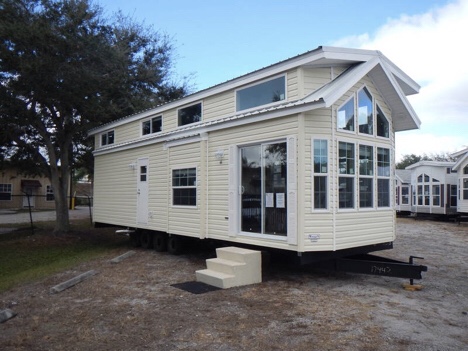
It’s my opinion that park models address a lot of the problems of other portable homes: unlike manufactured homes, they don’t require professionals to move and set them up; they’re better made and more ‘homey’ than RVs; they’re more spacious than tiny homes. They’re not intended to be moved every day, but it’s not unreasonable to move one a few times a year, albeit not what they were really meant for.
•Portability: Almost as portable as an RV, park models are made to be moved. This is another option that would cost a fair amount to put on a ship, and I’m uncertain about the legality of transporting them without a professional driver in some countries, though I don’t know why it would be any more of an issue than a large RV. Portability score: 3
•Ease of setup: Setup is the same as an RV or tiny house; typically you’d want to add a deck or skirting, but the time to make the u it fully functional as a home should be just a few minutes. Setup score: 4
•Quality of materials: It depends on the manufacturer, but the park models I’ve seen are very well-built, similar to a modern manufactured home with things like wood or cement board siding, double-pained vinyl windows, sliding glass doors and normal, residential entry and interior doors, and asphalt shingles roofs. Materials score: 4
•Use of space: There’s just a lot to be said for a bedroom that you walk into as opposed to climbing, being able to stand up when you get out of bed in the morning, and taking a dump in a standard toilet. Two people can live in one of these things as long as they don’t have hobbies that take up a lot of room. Space score: 4
•Suitability to the climate: They’re as suited to any given climate as a manufactured home or tiny home; I’ve discussed this elsewhere. Climate score: 3
•Pest resistance: Pest resistance should be about the same as a manufactured home. I don’t remember what score I gave them, so let’s just go with
• Pest score: 4
•Style: These are slightly less stylish than tiny homes, as much of what makes a tiny home stylish is its small size, and these are, you know, bigger. Style score: 4
•Sustainability: Depends in the manufacturer, bla bla blaSustainability score: 4
•Price: Park models aren’t cheap, but you can get financing. I haven’t researched it, but I suspect they hold their value better than so,e of the alternatives. And if you just call it a tiny house you can probably add 20% to the asking price. Price score: 3
Total score: 33
Biggest pro: They’re just the right size for comfort and functionality.
Biggest con: Price, maybe? I don’t have many bad things to say about these.
Most unique feature: It’s a regular house that you can move with your own truck.
 year 45