I’ve spent a fair amount of time on boats in my life, but I’m not a boater, per se. I’ve always liked boats, but my friends with more experience have told me that a boat is a hole in the water where you throw money. None of my experienced boater friends own boats. That’s probably something to take to heart. Still, the appeal of living on a boat is hard to shake, and it’s also the last of the sort of atypical housing types that I haven’t tried yet.
Obviously to live on a boat you have to have water, and the ‘type’ of water will have some bearing on the type and size of the boat. For the sake of this entry, I’m going to divide them into two categories: liveaboards and houseboats. Don’t read too much into this distinction — a houseboat is technically a liveaboard, but I’m drawing a distinction based on form and function: one group are boats you can live on, and the other are houses that are also boats.
Liveaboards are a pretty broad group; they can be motoryachts, trawlers, tugs, sportfishing boats or sailboats, provided that they are large enough to accommodate a person full-time, which for me means I don’t bump my head, I don’t have to crawl or duck, and I can get in and out of the bathroom without contorting my body into any weird positions. I’m 6’2”, so what works for me might be overkill for someone smaller, and totally unacceptable for someone larger. Liveaboards are oceangoing vessels, though not necessarily ocean-crossing ones — to move a liveaboard from Texas to, let’s say, Panama, I would either be crossing the Gulf of Mexico and taking a more direct route, or I might be hugging the coastline. There might be a transit of the Panama Canal involved. Alternatively, the boat could be trucked to the Pacific Coast, which seems way less fun.
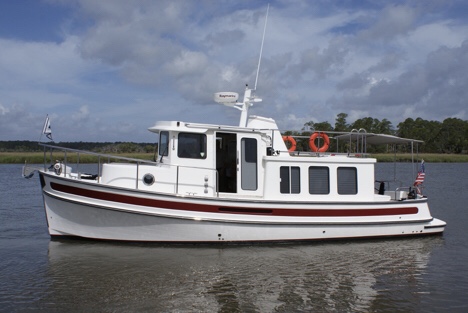
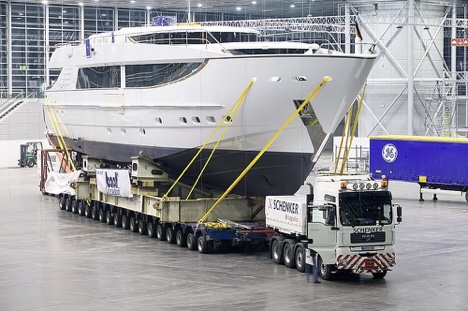
I had a thought, several weeks ago, after finding a property for sale in Texas that had a big pond with a houseboat on it — would it be possible to have a liveaboard docked in my own pond, and trailer it to the ocean or lake from time to time? Short answer: yeah, sort of. In order to trailer a boat without an oversized load permit it has to be under 8.5 feet wide, and while there are liveaboards that small, it’s pretty tight quarters. (See previous comment about head bumping and lavatory contortionism.) A roomier vessel would require a semi truck and at least one pilot vehicle, plus permits, which won’t be a problem when I win at Powerball, but it still seems like a pain in the ass. If the trip from the pond to the ocean was a one-time thing, for the journey south, that might be OK.
Once the vessel was at its destination, in a marina or a mangrove swamp, I think I would continue to take it out on the ocean, exploring islands, maybe doing some fishing. I’ve spent a bit of time on sailboats, and I’ve had some good days sailing, but I must admit I prefer the ability to travel in a straight line, which sailing doesn’t always afford, so for me, a powerboat is preferable. I like the look of tugboats and trawlers, but I also like the idea of retrofitting some kind of small, commercial vessel. I only wish I’d had a place to dock the Kalakala when it was being given away for nothing. I’d be living on it now. You’re going to want to google it if you don’t already know what it was — to simply call it a giant, floating Airstream doesn’t do it justice. And they fucking scrapped it. People are evil.
Moving on…
Houseboats, in contrast to liveaboards, are not oceangoing craft; they are lake and, to a much lesser extent, river vessels. For my purposes I’m including both self-propelled vessels and homes built on barges here. Where a liveaboard is a boat first and a house second, a houseboat is first and foremost a house. It is meant to float, more than to ‘go’; the living area is typically above deck, and they can be top heavy. To transport a houseboat to Central America would be a feat; it would have to be taken on a transport ship. A larger barge house might have to just be built on site.

Assuming the issues with transport could be resolved, a houseboat is likely to be more comfortable than a liveaboard, unless it’s a very large liveaboard. Houseboat living could be likened to tiny house or RV living at the smaller end of the size range, or apartment living at the bigger end, if you could jump off your apartment balcony and go swimming.
I should take a moment here to also mention narrowboats, which you don’t really see in North America, but rather in canals in England and elsewhere in Europe. Narrowboats are… um… The reason they’re so narrow is that they have to fit through narrow locks, and they’re not suitable for navigating anything other than rivers, canals, and lakes. (Some have crossed the English Channel— thanks, I have Wikipedia too, shut up.) Today, narrowboats are used mainly as houseboats or for recreation, and they come up for sale fairly often, sometimes for very cheap. Moving one to the US from Europe would be somewhat less cheap, and really, what would be the benefit? I have a hard time with the standard 8.5-foot-wide travel trailer, so I’m not sure how I’d cope below deck on a boat twenty inches narrower than that, even if it was sixty or seventy feet long.
I should mention that I have designed a truly badass timber frame barge house with a rooftop garden that I’d love to build, bu— omigod omigod omigod what if instead of Texas I move to a Great Lakes state and build this thing and then get a tugboat and take it to Panama, transit the canal, and dock it in the mangroves… holy shit someone give me millions of dollars.
•Portability: On land, not so great, but on water, way better than any of the other types of homes I’ve written about in this series. This also depends on the time of boat and the types of properties the boat is traveling between, so I’m just going to split the difference here. Portability score: 3
•Ease of setup: The setup here is comparable to an RV or tiny house, except there’s no leveling. Tie it to the dock and hook it up to utilities, Setup score: 5
•Quality of materials: Boats tend to be at least somewhat well made, since they have to float in water. A leak in a house is annoying, but in a boat it’s a catastrophe, so if a boat is suitable for living on, it’s probably made of good stuff. Materials score: 5
•Use of space: I don’t know how to even score this, because we could be talking about a cramped cabin below deck on a small cruiser or what’s essentially a regular house on a barge, so I’m going to just say Space score: 5
•Suitability to the climate: The only big climate issue has to do with storms; a hurricane can wipe this home out if it’s in a coastal area, while a similar ‘land home’ might barely sustain any damage. If it’s not in a storm-prone area, not really a problem. I don’t know much about heating or cooling a boat, but I don’t know why it would be that different from any other structure as long as there’s an adequate power supply. Climate score: 3
•Pest resistance: Let’s see… rats were spread around the world by ships, but they got on the ships by hiding in cargo. A docked boat is accessible to rodents, but what if I take it out to the middle of a lake and load it up with cats or snakes or something? I think the best argument for a boat being pest resistant is that the points of entry could be minimized, and they’re certainly not getting in through the bottom like they do in most other types of homes. Pest score: 4
•Style: I mean, it’s a boat. Style score: 5
•Sustainability: Fiberglass, steel, epoxies, varnishes, rare hardwoods, fuel-guzzling engines… Sustainability score: 1
•Price: My friends do call it a hole in the water where you throw money. Price score: 1
Total score: 32
Biggest pro: Potentially the most exciting house move
Biggest con: A weird option for a landlocked property
Most unique feature: How can I pick just one? I mean, it’s a boat! You get to constantly yell, “I’m on a boat!” Or you can just say it, all low-key like. A boat is the inverse of a house with a swimming pool. You can tell people not to rock the boat and let them decide what you meant by that. You can go fishing and watch TV at the same time. If you don’t want to invite someone to your house party you can just make up some fake maximum occupancy bullshit and tell them they’re wait listed because the boat will sink if you have too many people there.
 year 45