There are various homes designed for something very near what I’m trying to do, that don’t fit well into any of the categories I’ve already written about, or they fit into more than one category, so I’m cramming them all in here. I’m not going to score these but I’ll do the pros and cons thing at the end of each one.
Boxabl: These are pretty cool. Boxabl is a 375 square foot, fully equipped home that folds up for transport. It’s also modular — you can join separate units side by side or you can stack them. There’s nothing to install once the home is opened up and snapped together, which takes about an hour. You build the foundation and hook up the utilities. The collapsed unit at time of shipping is about 8’x20’x10’ and is light enough to tow behind a pickup. Setup requires a small crane or a telehandler. Boxabl currently has only one size and floor plan, but the company says more are on the way, ranging up to 1,200 square feet. The current model costs $49,500 and the company offers third party financing; they are not available for purchase at the time of this writing, but you can reserve one, and I’m seriously considering it. The unit is made of concrete, steel, and EPS foam, so a lot of the problems you get from more ‘traditional’ building materials like mold and insects are eliminated. Boxabl even claims that because of the materials they use, the home can be flooded and suffer no damage.
A Boxabl won’t fit inside a shipping container, so shipping abroad would be as cargo or possibly trailered on a Ro-Ro; I could see shipping truck, trailer, and home on the same ferry and just waiting in a local hotel while it all clears customs. This option honestly makes a ton of sense to me.
I’ve looked at several other companies selling collapsible homes that set up in anywhere from several hours to as little as ten minutes, but I haven’t found any at Boxabl’s price point that are also available in a North America, so I’m not going to bother with them here.
Biggest pro: Fastest package-to-finished home time
Biggest con: Looks kind of sterile to me.
Most unique feature: Because it collapses for transport, you’re not shipping empty space — Boxabl has pros of park models and tent homes with less down side.
Treehouse tent: DOM’UP is a 200 square foot treehouse tent for about €20,000; it is suspended between two trees, and the company recommends using a professional arborist or at least someone with major knot-tying skills to install the unit; I believe with some practice a person could learn the knots and sort out the rest. There also a yurt version, available from a partnering business, for those who don’t want the open air style of the standard tent. At about $120 per square foot at the time of this writing, the cost of this unit is, like the treehouse itself, up there (groan), but one of the most striking advantages of this structure is that it doesn’t need a foundation, just two, sturdy trees, 18-40 feet apart. If I were going to stay in this thing I’d probably put it a little closer to the ground, just to save myself from having to go up and down a tall ladder that might not have such a sturdy base — with half a million ladder-related injuries and 300 deaths a year in the US, it would be worth it to me to take a few extra hours and build some steps. In the event I ended up making the treehouse into an AirBnB, my insurance company would likely agree. I’ve watched a setup video and it looks like it would take a day or two, depending on how many people you have helping; you also need a truck or tractor, or at least a winch, to raise the unit off the ground.

Biggest pro: No foundation, so very little prep work is needed.
Biggest con: No bathroom + ladder = nighttime ladder climbing or trying to shit over the edge; neither activity is particularly safe
Most unique feature: It’s a suspended treehouse — duh.
Mars Dome: This is a weird little studio home sold by SimpleTerra for around $16,000. The dome’s diameter is twenty feet, so it’s about 314 square feet, which you know because you remember your middle school geometry and the math is particularly easy when the radius is ten feet. The company claims their dome takes about an hour and a half to set up with a helper. I wasn’t able to find whether or not the floor is included, and I didn’t want to call the company to ask, but feel free. Each unit has an entry door and two windows. The dome design is sturdy and the materials are easy to clean; Mars Domes are in use in both extreme heat and extreme cold and are said to perform well in both scenarios. They have been used for emergency housing as well. After a lifetime of working with animals, to me these things look more like Dogloos than ‘space houses’, but one buyer outfitted his to look like R2D2’s head, and after comparing it to a picture of the real R2D2, it doesn’t really look like him. And yeah, R2D2 is male.
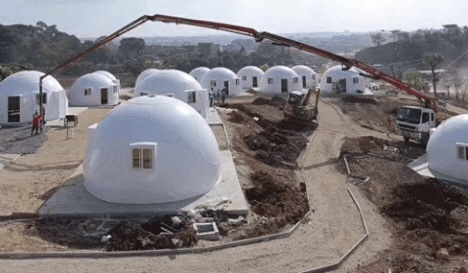
Biggest pro: Quick, simple, and easy
Biggest con: One door is problematic for me, and the windows are pretty small, in the event the door is blocked.
Most unique feature: It’s a little plastic dome. ‘nuff said.
Inflatable concrete canvas shelters: This one’s kind of out there, so bear with me. These are rapid-deploying shelters made of fabric that’s impregnated with Portland cement, with an interior waterproof liner. One end has a rigid doorway. The construction process consists of rolling out the canvas, inflating the structure with a powerful air pump (included), and spraying the whole structure with water to begin the curing process. Once the concrete is set, you can disconnect the air pump and you’ve got yourself a building. If you’re careful, you can probably then install some windows. If you want to make the structure into a bomb shelter you can pour more concrete on it. As for the ‘home’ you end up with, if you want a flat floor you should set it up on a concrete slab, and if you want flat walls you’re out of luck. As for the price, I’ve seen a lot of different numbers thrown around, from just over $2,000 to over $30,000, and honestly I don’t know if civilians can even buy these things. But if I had money to burn, I might get one just for the hell of it.

Biggest pro: Quick setup
Biggest con: I’m gonna be honest — this might be the ugliest structure on earth.
Most unique feature: It’s no ‘lead zeppelin’, but it is a concrete balloon. (If you @ me about spelling “lead” wrong I’ll punch you in the dick.)
Planes, Trains, and Automobiles: I really like the idea of converting vehicles into homes. I’m not saying that an operable airplane is a good option for a home, or that an inoperable plane is technically portable; what I really like is the thought of staging a retired plane as if it had crash landed and then decking out the inside in spectacular fashion.

As for trains, I’ve always wanted to convert some train cars into a home, ever since I was a kid and went to that McDonald’s in Barstow, CA (the one with the train cars). Are train cars portable? Not really, unless there’s a railroad between the place you are and the place you’re going, although train cars can be moved by trucks with an oversize load permit. A train house is cool, though, in spite of its limited portability.
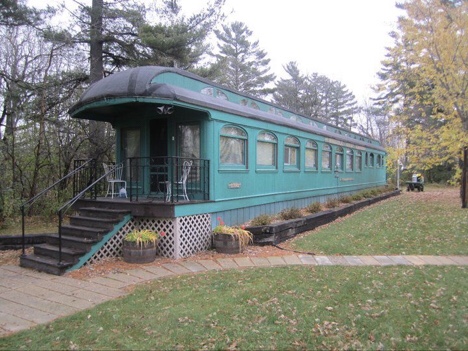
And finally, automobiles, which I just included here because of the movie title, and if somehow you don’t know what I’m talking about you don’t deserve an explanation. I’ve lived in automobiles and it’s not great, but you know what is kind of cool? A house made from an upside-down boat. Or a boat cut in half and stood on its end. Is it portable? Who cares? Just look at the pictures and then do your own image search and see what’s out there.

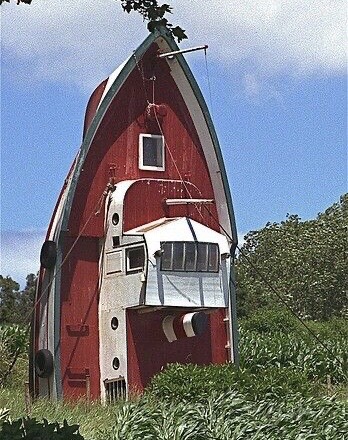
Biggest pro: These homes are cool as shit.
Biggest con: These aren’t as much ‘portable homes’ as they are ‘huge, money-sucking, multi-year projects’.
Most unique feature: How many people do you know who live in an airplane?
What about … 3-D printed houses? Emergency shelters? All the other oddball structures out there? And there are a lot of them. What I’ve found is that the vast majority of alternative housing options fall into one of two categories: 1) low income or emergency shelters that are only available to government agencies and nonprofit organizations, or 2) extremely expensive toys for the super-rich. I’m neither of those things. But if you know of a viable, portable home that I haven’t discussed in this series, I’d love to hear about it.
 year 45