
I thought it might be kind of fun to write some profiles of the different animals I raise — what makes them unique, why I like them, and my goals for the species and/or breed. I’m going to call these ‘breed spotlights’ or something to that effect. I’m raising somewhere in the neighborhood of twenty-five animal breeds at the moment, but if I run out, I may start writing about some that I hope to work with in the future.
I’m starting with Muscovy ducks, for the sole reason that they’re what I was chasing around the yard last night when it occurred to me to start writing these entries.
First things first, Muscovy ducks are not, as their name suggests, from Moscow, but rather, they originated in Mexico and Central and South America. There was a time when people knew even less about geography than they do now, and it was around that time that some new animals started showing up in Europe. Specifically, Muscovy ducks first went to Europe on one of Christopher Columbus’s return trips. So if you’ll indulge me…
An Italian rapist, slaver, and murderer, who may have actually been a Spaniard posing as an Italian to escape his debts, or possibly from criminal charges, sailed to North America, which he thought was Asia. Despite being credited with its discovery, he never found the mainland, there had already been people in the Americas for thousands of years, and even if you’re so racist as to believe that those people don’t count, other white guys from Europe had made it to North America over 500 years earlier and actually settled there. Incidentally, those guys, who were largely peaceful, are the ones who got the reputation for raping and pillaging, while Columbus got a national holiday and a bunch of shit named after him, including, but not limited to: a river, a US district, an Ivy League university, a city in Ohio, eighteen cities in other US states, a city in Panama, a salami company, the national currencies of Costa Rica and El Salvador, a Canadian province, an entire country in South America, a Martian crater, and a fucking sportswear company. I console myself by believing that he’s also the namesake of the lower intestine, adjacent to the asshole, which is just as true as the notion that he discovered America.
To put it more briefly, people got a lot of facts wrong at the time, and those facts had a tendency to stick. Such was the case with the Muscovy duck, as there was a trend in those days of slapping the label ‘Muscovy’ on anything exotic. Other labels that were frequently misapplied included Guinea, Barbary, and Turkic; I’ll save my story of how the turkey was misnamed for another time, but in the case of the Muscovy duck, it carries the distinction of being mislabeled many times over. In the culinary world it is often referred to as the Barbary duck, ‘Barbary’ referring to North Africa, from whence the duck also definitely did not originate. In Spanish, the duck is called pato criollo, ‘criollo’ meaning ‘of Spanish descent’, and a term applied to people in Latin America, as well as breeds of cattle, horses, goats, and sheep, plus a chicken recipe. The Spanish misnomer adds insult to injury, given Spain’s history in Latin America of stealing things, giving a little bit back, and expecting to be thanked for it. It’s kind of like if I stole all your money and burned down your house, and then when I found you begging on the street corner, I dropped a quarter in your cup and said, “Oh, by the way, coins are called Steves now,” and then instead of asking people for spare change, you asked them if they could spare a Steve or two, and if you were really lucky maybe someone would even give you a paper Steve. So you’re standing there, thinking, ‘Where would I be without Steve? He’s so important, even the money is named after him!’ And out of pity, no one reminds you that without me, you’d be living in your not-burned-down house and spending your not-stolen money instead of experiencing homelessness and begging for spare Steves, which wouldn’t even be a thing. Basically that’s what I think about every time a white person proudly tells me how Europeans brought culture and language to the Americas.
So… ducks, right? There are other Spanish names for the Muscovy duck, including pato negro and pato real, but this of course raises some issues in that there are other duck species commonly called pato negro, which translates to black duck, plus not all domestic Muscovy ducks are black, and there is another species called the American black duck, which is more closely related to a mallard. Pato real is a name also applied to mallards. Basically, common names are a mess, but for various reasons, it’s not realistic to expect people to use scientific names, not the least of which is that they’re hard to pronounce, hard to spell, and when you type them they’re supposed to be in italics, which is just an extra pain in the ass. Besides that, the Muscovy duck’s scientific name, Cairina moschata, means… you’re not going to fucking believe this shit… moschata may or may not refer to Moscow, as people at the time also claimed the ducks had a musky odor, something I have not noticed personally, but maybe I’m just used to it. It’s possible that the entire ‘Muscovy’ nomenclatural debacle arose from people mistaking a description of the duck’s odor with a description of its native origin, however, its genus name, Cairina, means ‘from Cairo’, as in the capital of Egypt. Like Barbary, Cairo is also North Africa, obviously, but not part of the Barbary region. So by my count that’s a quadruple misnomer, but there have been other names applied to this poor duck over the centuries that have fallen out of use, including Libyan duck and Guinea duck — both also African. It seems the only name this duck has never had, at least in recorded history, is one that accurately represents its place of origin. I know the duck doesn’t care, but I find it all pretty frustrating.
Oh, and a lot of people who keep these ducks refer to them as ‘scobies’. Yeah.
Honestly, I’m getting a little worked up and I need to take a few minutes and maybe break some shit.
________
I’m back, and I feel much better. With all the above unpleasantness out of the way, I will now, finally, talk about the ducks themselves. I’ll start by saying that I didn’t like Muscovy ducks at first, for the obvious reason that they’re ugly as hell. But then I met some in person, and there was just something about them…
Muscovy ducks are ‘tamer’ than the mallard-derived duck breeds, which I’ll profile at another time. They don’t run away in terror when I enter the yard. In contrast, I once hand-raised a Cayuga duckling, which imprinted on me and followed me wherever I went; that duck has since joined the others in my flock and is now just as afraid of me as they are — I couldn’t even tell you which of them is the one I ‘mothered’. Muscovy ducks, on the other hand, tend to get underfoot. The drakes follow me around, bobbing their heads, wagging their tails, hissing, and occasionally biting. I periodically nudge them with my foot to remind them of who’s bigger and stronger; their bites don’t hurt, they’re just kind of irritating.
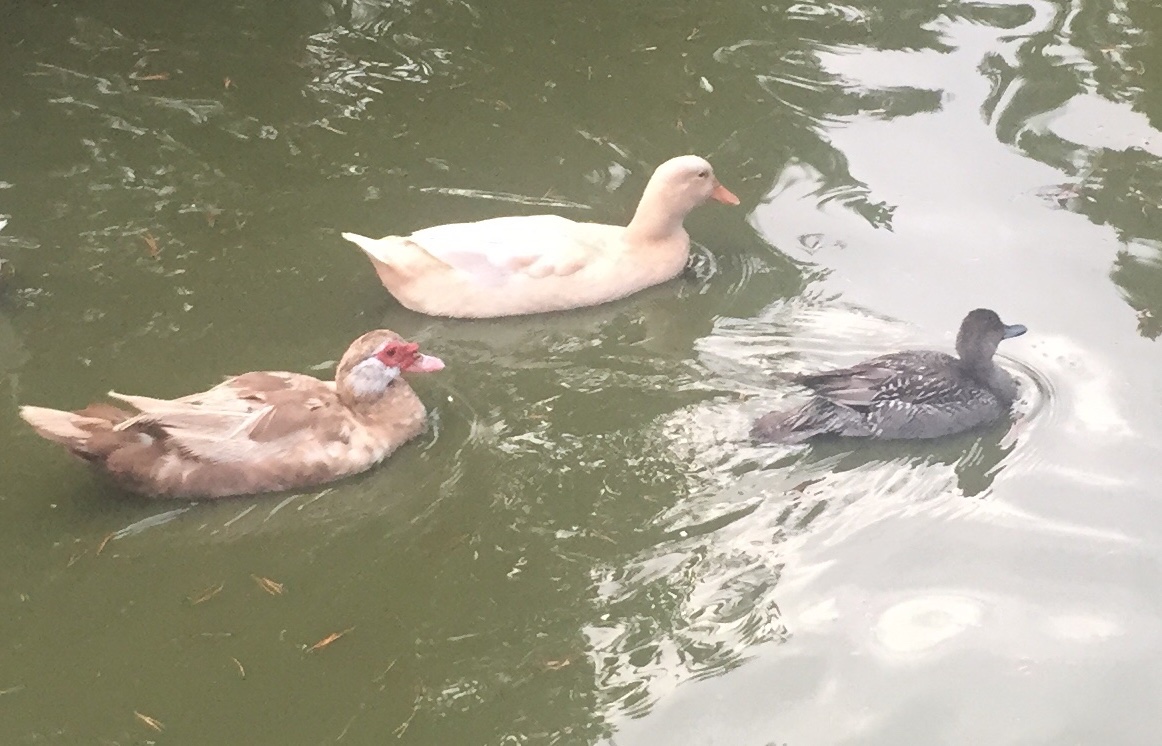
Muscovy ducks swim well and they like the water, but they spend less time in the pond than other ducks or geese. They might only swim once a day, especially as they get older. They are less ‘waterproof’ than other ducks — the water doesn’t always bead up and roll off of them the way you’d expect. Sometimes they look downright soaked. They also tend to sit lower in the water; they remind me of loons and grebes in that way.
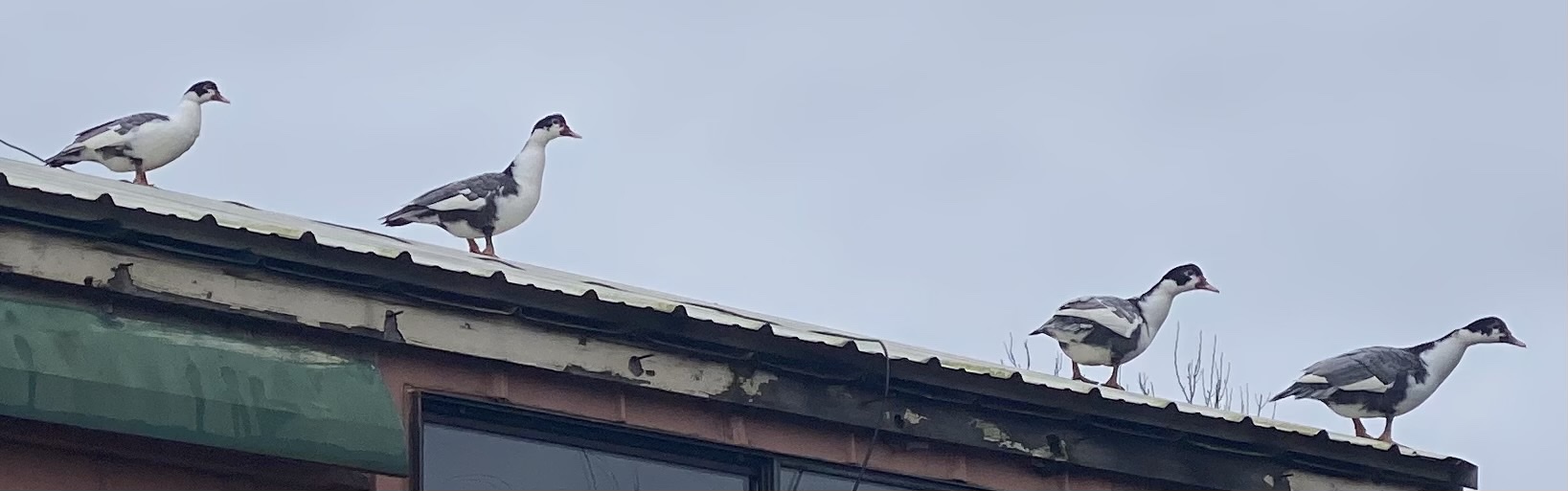
Muscovy hens can fly, as can some of the smaller drakes, though not quite as well. When I say they can fly, I don’t mean that they get airborne for a few seconds before crashing back to earth, like you might see a chicken do. I mean that they fly, fifty feet off the ground, for a few hundred yards, or basically as far as they feel like going. They fly almost as well as the wild mallards and teals that visit my pond. They’re always on my roof, or maybe a neighbor’s roof. They’re perching ducks, so they sometimes use the same roosts as my chickens and turkeys. They even lay eggs in the chicken nest boxes on occasion.
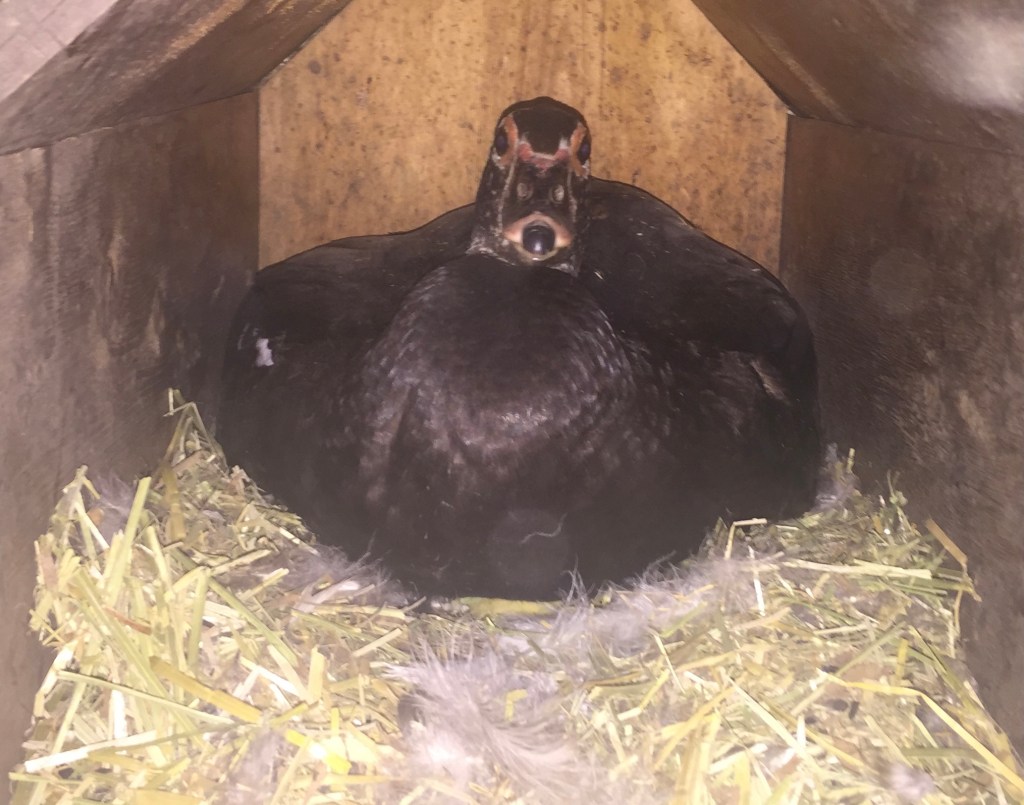
Speaking of laying eggs, Muscovy hens are more likely to do so in the barn, which I appreciate. While my mallard hens are making outdoor nests and often failing to keep them protected from the elements, not to mention exposing themselves to nighttime predators, the Muscovy hens use the boxes I’ve made for them indoors — they like to be sheltered and well-hidden. Despite the hens being smaller than the mallard breeds I raise, and about a third the size of a Muscovy drake, their eggs are larger and take an entire week longer to hatch. Even so, my Muscovy hens manage to cover and successfully hatch about a dozen eggs at a time.
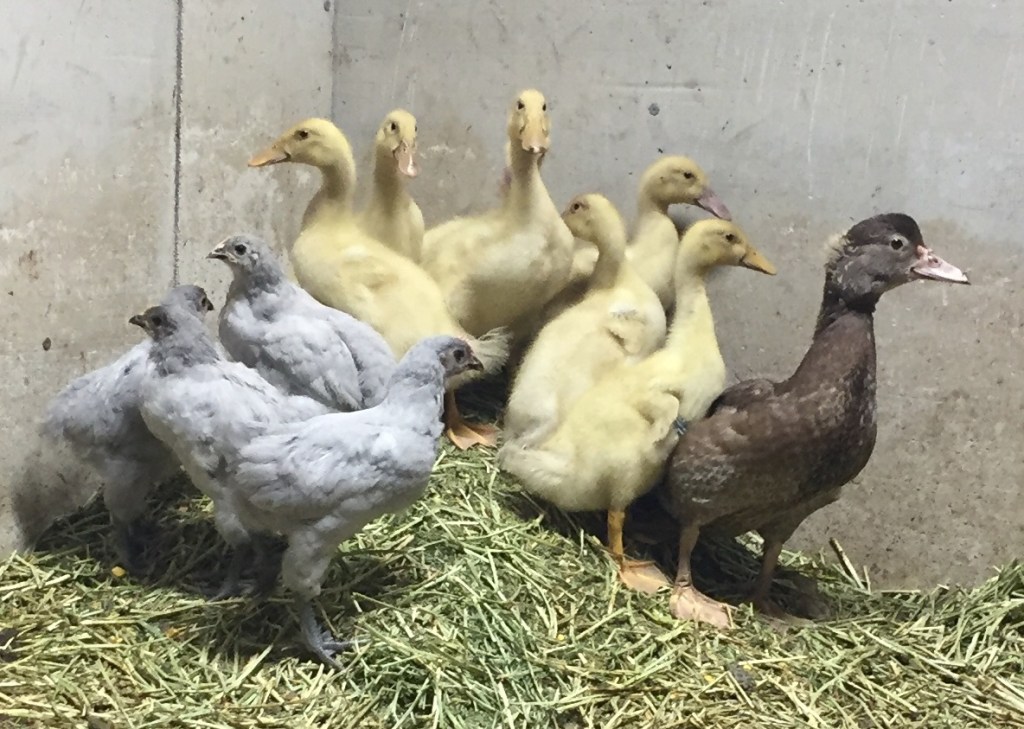
Muscovy-mallard crosses are common in aviculture, and the resulting ‘mule ducks,’ which are sterile, are said to have excellent meat properties. I haven’t cross-bred them yet, but I intend to at some point. The cross doesn’t seem to happen very often without human intervention; the closest I’ve come was having a Muscovy hen hatch a couple of mallard eggs along with some eggs of her own; fortunately, it appears that the mallard hen sneaked her eggs into the nest about a week after the Muscovy hen started setting, so they all hatched within a day or two of each other.
I should also note that Muscovy ducks do not quack, prompting some people to call them ‘quackless ducks’. I should also also note that a Muscovy hen does, in fact, very rarely, on special occasions, quack, or at least one of mine does. More often, the hens chirp and whistle and make other, various, fairly quiet noises, especially when they’re nesting or caring for ducklings. Adults of both sexes ‘pant’ — sort of a repetitive hissing that scares the hot shit out of anyone creeping around my poultry yard at night. The drakes do this constantly, to an annoying degree, but it becomes less annoying and more comical over time; they live to pant, bob their heads, and wag their tails. And to sometimes mate, which is, as with other poultry, unsettling to watch, but is made all the more disturbing by the conspicuous presence of a substantial and corkscrew-shaped penis.
Muscovy drakes like to fight, and unlike other waterfowl, they use their feet, which are armed with long, sharp claws. I’ve been opened up by them on more than one occasion. Most of their fights involve biting and beating each other with their wings, but it’s also not always each other that they’re fighting — I’ve had them get into it with roosters and turkeys before. Most of the time the fights are fairly harmless and they work themselves out, but occasionally I do intervene.
Muscovy ducks are crested; when aroused or agitated, they raise their crest feathers, reminding me of mergansers. Or maybe water cockatoos. My first drake reminded me of an Elvis Presley impersonator, but just kind of an OK one — like one that you would see and be like, ‘Oh that’s fun,’ and then after a few minutes you’d be ready to go do something else, and your friend would say, ‘There’s still another hour left in his set,’ and you’d be like, ‘Oh fuck of, I don’t even like Elvis.’ They are simply very expressive, communicative birds, and I enjoy them immensely.
They are less social than my mallards, which is not to say they aren’t highly social birds — they just don’t flock together to the same extent, preferring instead to go around in pairs or trios, more like chickens do. As with chickens, this behavior becomes more pronounced as they age. The drakes tend to form pairs with one another and stake out territories around my yard. The hens usually have a pair of drakes that they spend most of their time with, but they sometimes change their minds. I’ve isolated hens and drakes for breeding and had the drakes reconnect with their male partners weeks later. It’s a pretty interesting behavior that I haven’t read about anywhere else; I’m curious to see if it continues with the younger generation of drakes that has joined my flock, and if the behavior changes when I reach the ratio of more hens to drakes that I’m aiming for. I currently have a couple more drakes than hens.
In terms of color and pattern, we start with the standard black bird with white wing patches, referred to as wild type. ‘Wild type’ is a term used for all poultry, and in gene symbols it is denoted by a plus sign. For example, the gene on the blue locus is called N; black is wild type, and it is recessive to blue, so its symbol is n+. (I’ll say more about blue in a moment.) On the chocolate locus, black is dominant, and its symbol is Ch+, while the symbol for chocolate is ch. If that doesn’t make sense to you, you’re going to love this next part.
The color and pattern genetics for Muscovy ducks are poorly documented compared with other poultry, and there is some disagreement over the existence of certain genes. As with any domestic animal, new genes can also arise at any time; typically, a genetic mutation occurs in nearly every generation, but most of these mutations are inconsequential, resulting only in genes that are not expressed in any observable way. Sometimes, however, these mutations are very obvious, and interestingly, they can even be predicted — certain traits, or phenotypes, correspond to specific genes, or genotypes, in identical ways across different species, in which similar mutations have arisen entirely independently of one another.
For example, chickens, mallard-derived ducks, Muscovy ducks, domestic geese, turkeys, ringneck pheasants, Guinea fowl, and Coturnix quail all have a dilution gene that behaves very similarly; otherwise black or dark gray birds with one copy of the gene (one allele — heterozygous) are ‘blue’, while those with two copies (two alleles — homozygous) are even lighter in color. In chickens we call this ‘splash’; in ducks it’s silver; in geese it’s lavender (depending on whom you talk to), while in chickens and ducks, lavender is a different, recessive gene. In pigeons, the dilution gene exhibits the same incomplete dominance, or if you prefer, dominance with dosage effect, except there are multiple versions (dilute, extreme dilute, pale, faded, almond…) and the gene is sex-linked, meaning it is located on the same chromosome that determines the bird’s sex. In most birds, the sex chromosomes are W and Z (as opposed to X and Y in most mammals), with male birds carrying two Z chromosomes, while females are WZ. Since the dilution gene is on the Z chromosome, females can only carry a single allele, but males can carry two; this allows for the breeding of autosexing birds — birds whose sex can be determined visually from the moment they hatch. In a future entry I will discuss autosexing Texan pioneers, which are (probably) not some weird religious group you’re just now hearing about, but rather, a pigeon breed that I raise. There is also a similar dilution gene in cattle, but since cattle are mammals, it’s the female who gets the double dose and is lighter in color.
But getting back to Muscovy ducks…
Here’s a quick rundown of the colors and patterns:
Color genes:
• Blue: Nn+ is blue, n+n+ is wild type, and NN is called pearl-gray or silver.
• Lavender: L+ is wild type and l is lavender, so only homozygous lavender birds appear lavender. It is difficult to tell the difference between silvers and lavenders, and I was sold two silver drakes that I was told were lavenders, despite my specifically asking the seller to assure me that this was not the case. Only when I bred one of them to a chocolate hen and got all blues did I know that I had been ripped off, probably not intentionally — I’ve found that a lot of people who sell poultry on Craigslist don’t know what the hell they’re talking about.
• Chocolate: Ch+ is wild type, ch is chocolate; chocolate is sex-linked, so males must have two alleles, but females only need one. Breeding a chocolate drake and a black hen will produce chocolate hens and black drakes with one chocolate allele; breeding a chocolate hen and a homozygous black drake will produce all black offspring, but all the males will carry one chocolate allele, which we call ‘split chocolate’ or being ‘split to chocolate’.
• Sepia/faiogeno: F+ is wild type, f is sepia; it is called bronze in the US according to some sources, but they are separate genes according to others. One source states that the gene is indistinguishable from chocolate, except that it changes the skin and bill color, but a side-by-side photographic comparison that I’ve seen shows sepia appearing darker than chocolate. I still don’t know if it’s the same as bronze. Also, do not ask me how the hell to pronounce faiogeno. You will find that with domestic animals, there are a lot of words that seem not to exist within any other context, and finding any information on their etymology can be difficult. Given the amount of time I devoted to the misnomenclature of the Muscovy duck at the beginning of this entry, I feel it would be best if I gloss over these for the time being, but feel free to do your own research on faiogeno, as well as Canizie and Duclair, which you’ll see in a moment, and which I am capitalizing only because I think they might be proper names, but I have simply not yet taken the time to find out.
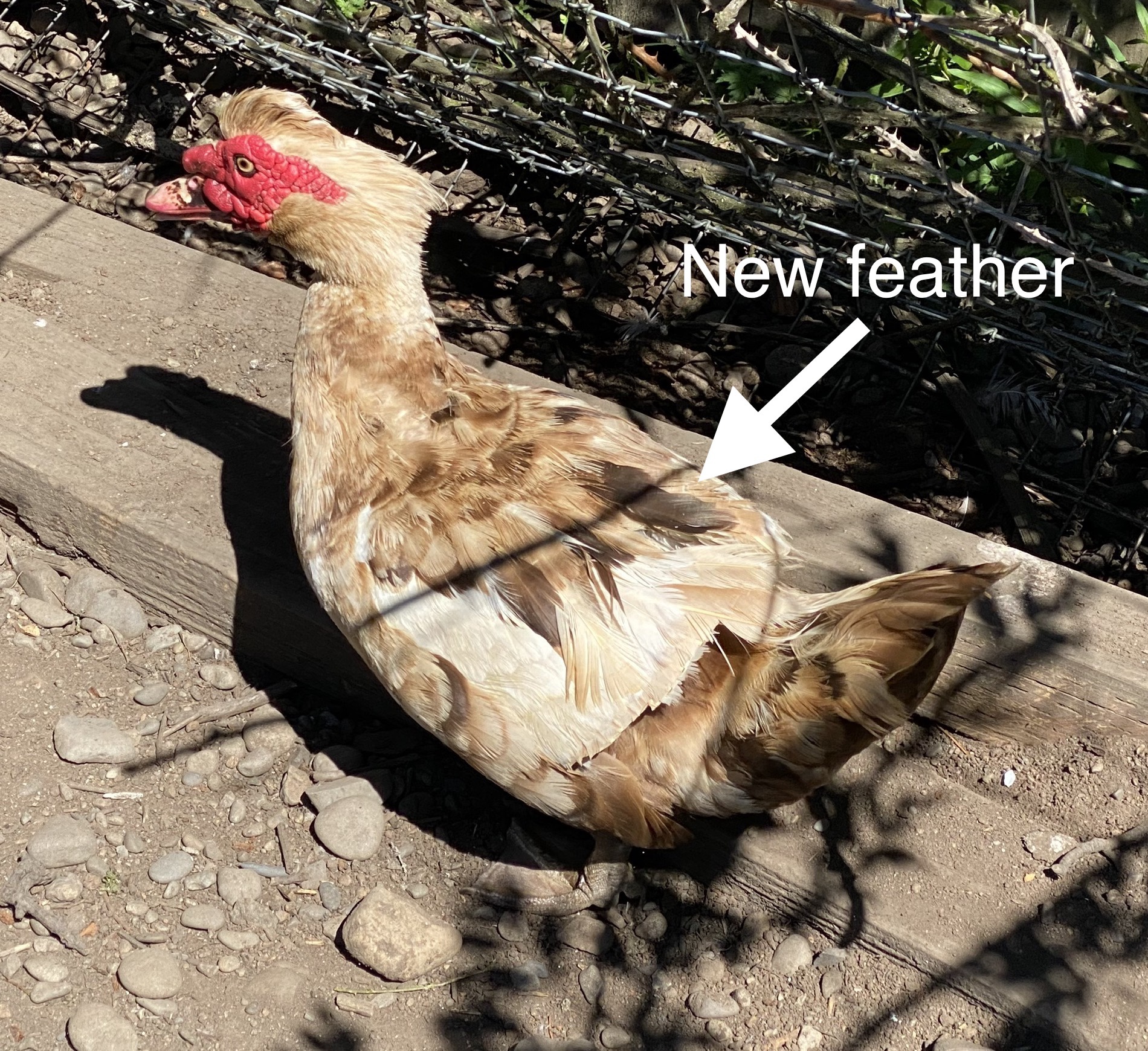
Color combinations:
• Lilac: blue + chocolate; some call this ‘blue fawn’.
• Buff: silver + chocolate
• Cream: lavender + chocolate; it’s starting to sound less like a duck and more like a dessert.
• Light lavender: lavender + blue
• Silver lavender: lavender + silver; most people would just say it’s white, but it’s not.
• Three-part combinations simply combine the same terminology, so you get lilac cream or buff cream. Adding sepia/faiogeno to any of the above adds that to the name, so you could have a faiogeno lilac cream, for instance. And it would mostly just look white. Then we have the…
Pattern genes:
• Atipico: A+ is wild type, a is atipico; I don’t fully understand what this gene is, and there is conflicting information online. If I’m understanding it correctly, it reduces or eliminates the white wing patch and may also give the plumage a brownish cast. Or maybe it only does one of those things. I believe I have this gene in my flock, however it could also be…
• Self-color: a recessive gene with a similar effect to spread in pigeons, which basically means that the darkest color on the bird spreads across all, or nearly all, of its plumage. I don’t know if this gene even exists in Muscovy ducks, and I don’t trust the source where I read about it.
• White/pied: P is pied and incompletely dominant; p+ is wild type. PP is white and Pp+ is pied. White isn’t exactly a pattern, but pied is, so I’m putting this under pattern genes.
• Barring: B+ is wild type, b is barred; barring fades with age, and as such, I don’t see the point, but I guess some people like it. It’s not as tidy or as uniform as the cuckoo barring you see in chickens.
• Brown rippled: Br+ is wild type, br is rippled; unlike barring, ripple does not fade with age, and it also looks better. I am very interested in getting this gene into my flock, so if you have it, please contact me.
• Canizie/white head: C is canizie, c+ is wild type; C is incompletely dominant, thus heterozygous birds develop a somewhat blotchier white head after their first molt, but the base color tends to remain present as a dorsal stripe.
• Duclair piebald: D+ is wild type, d is Duclair; d is a ‘neater,’ more uniform piebaldism than P. Some call this magpie. It appears to actually be incomplete dominant based on my flock, but results could indicate the presence of P, so I need to do more breeding to be sure. I was initially planning to breed out all the white markings from my flock, but after I bred a bunch of blue Duclairs by accident, I changed my mind, and decided to keep Canizie, too. I just don’t want both in the same bird, which I have now.
• Lacing: Lacing occurs when the edge of a feather is a different color than the rest of the feather. It may be a Muscovy pattern gene, but its existence is disputed. I have no opinion; some of my black birds appear to exhibit some lacing, but I don’t know if it’s unusual, and it’s not a major concern of mine at the moment.
• White wing tips: Dominant, according to the same, questionable source as some of the above. I have some white wing tips in my flock so I should be able to test this. It’s not a trait I want, so if it is dominant I should be able to get rid of it fairly easily. (Dominant traits are easier to eliminate; recessive traits are easier to lock in.)
• White shoulder patch: no idea
• Bib: no clue if this is real, but if it is, I don’t want it.
• Loony: barred + rippled, supposedly giving the bird a similar appearance to a loon. I don’t know if the barring persists past the first year when it’s found in combination with rippling, but I don’t care for the look of loony markings, so I won’t be experimenting with this.
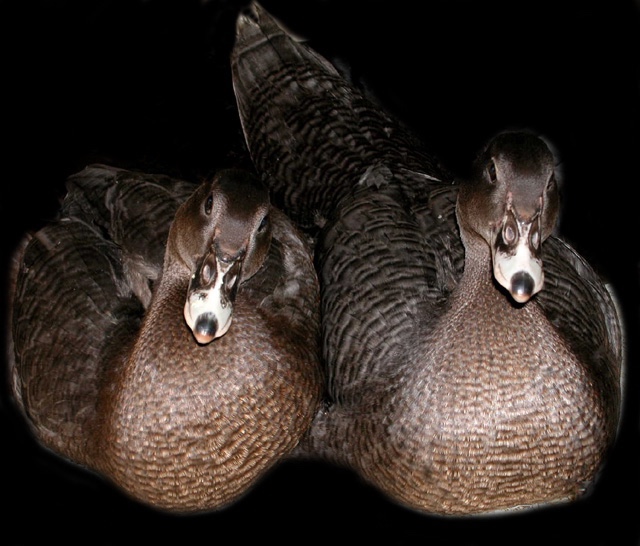
Now that you have all that memorized, a word about caruncles: caruncles are the red, wrinkly, warty growths on Muscovy ducks’ faces. They’re the ugly part — the reason I stayed away from these ducks at first. Both sexes have them, but they are more pronounced on drakes. In show lines, the caruncles can get quite extreme, and as they continue to develop throughout the bird’s life, they can reach a point where they overwhelm the poor drake’s face, even blinding him. As much as I have come to like Muscovy ducks, I do not like caruncles. I much prefer the look of a wild Muscovy duck, which has primarily black facial skin, accented with the occasional red wart. On the wild duck, the caruncles look almost like jewels, less like inflamed scrotal skin. I intend to select for reduced caruncles in my breeding program.
I can’t do it here, but when I get to a larger property, particularly if it is within the native range of the wild Muscovy duck, I would like to do some crossbreeding with wild ducks (which I would buy, not trap) to reduce the size of the caruncles even more. I don’t know how successful this will be, as it’s entirely possible that there is some link between the size and color of the caruncles and one or more of the other traits that make Muscovy ducks desirable as a domestic animal. That said, some of my older, larger drakes have less caruncle than at least one of my younger, smaller ones, so it seems promising.
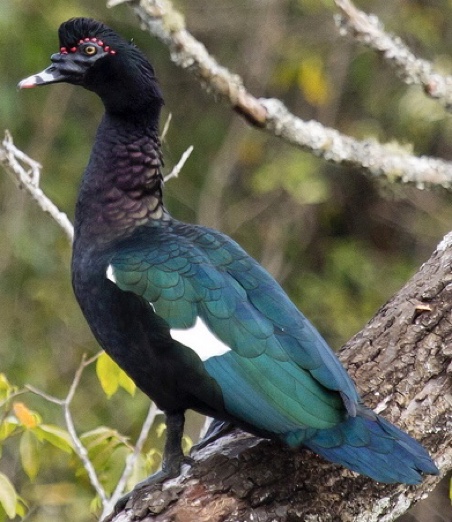
As for my goals with color and pattern, as I said above, I intend to keep the Duclair and Canizie genes in my flock, which I will eventually maintain as separate lines. I want to get to the bottom of the atipico gene — if it just eliminates the white wing patch, I want all my birds to have it. I will continue to breed blacks, chocolates, blues and silvers; I’m debating whether or not to bother with lavender. I will probably try to stay away from the color combinations that result in a very light-colored bird — that’s just a personal preference. I am very interested in finding some bronze/sepia/faiogeno birds, and I badly want that ripple gene in my flock. I do not want any white or pied birds (other than Duclair pied) — pied markings look sloppy to me, and white poultry, in my mind, is indicative of industrial farming. It looks unnatural. Clearly there are exceptions — various swans come to mind — but generally, I find solid white birds to appear sterile and artificial. It’s not their fault, of course. I have a white turkey I’m somewhat fond of, and I have some Embden geese coming this spring — they’re all-white, but I’m getting them for their size, not their color, and I’ll be breeding out the white plumage over time.
So that’s a wrap on Muscovy ducks, the duck so nice they misnamed it twice. And then at least two more times after that. Check back in the coming days for more of these species spotlights, which are about animals I raise on my farm, and not about history, politics, linguistics, or Elvis.
 year 45