Hear me, and heed my words.
There are a few things you learn pretty quickly when you raise animals: they get sick and injured fairly often, and even if you can afford a vet, there may not be a qualified one nearby. (In my case that means an avian vet; the nearest one is 75 miles away, but the one I prefer is a 135-mile drive.) If there is a qualified vet in your area, you may still have a crap shoot on your hands, which is better than crap shooting onto your hands, but not by much. Veterinarians simply don’t have the depth of research at their disposal that human doctors have, they have to know how to treat many different species, and they have financial constraints the people doctors don’t. Besides that, how many $500-1,000 vet bills can you afford to pay for birds that you eat? To some degree, compassion has to be balanced against the bottom line. So unless you want to let your animals suffer, or simply kill them whenever they have a health problem, you have to learn to treat their illnesses and injuries yourself. This is how I became the Chicken Jesus.
The Internet is awash with folk remedies for various poultry disorders, and most of them aren’t as effective as their proponents claim. Apple cider vinegar; yogurt; chicory root … most of these fall under the header of ‘it can’t hurt to try it’. You need more than folk remedies to be the Chicken Jesus. You need activated charcoal, ivermectin, heat lamps, feeding tubes, and lots of cages you can use to isolate sick and injured birds.
Ivermectin is a parasiticide used on a lot of farm animals for flies, lice, mites, and intestinal worms. Lately I’ve been using a cattle drench and applying it topically to any bird that seems a bit wimpy. I isolate the bird in a warm place where it doesn’t have to compete for food or space on the roost. If parasites aren’t the culprit, the treatment doesn’t hurt. I also treat the whole flock periodically, usually with a three-day course of ivermectin in their drinking water.
Injured birds go into isolation to recover where they won’t get pecked at by their flock mates. I’m usually dealing with leg injuries, but on two occasions I’ve had to nurse chickens with what I was sure were broken necks. One recovered quickly and the other took several weeks, but their necks straightened out and they were able to walk and behave normally. Leg injuries are especially common with female ducks in springtime, for reasons you can probably guess. I’m currently treating a gosling whose limp became worse over a period of three days; I moved her into isolation, where I set her in a position where she could eat and drink without having to stand — an arrangement she appreciated so much that she proceeded to sit, eat, and poop in one spot for days. To keep her leg from freezing up, and to force her to clean herself, I now make her swim in a water tank twice a day. She has begun to scoot around in her iso room and will hopefully continue to improve, though it could take months.
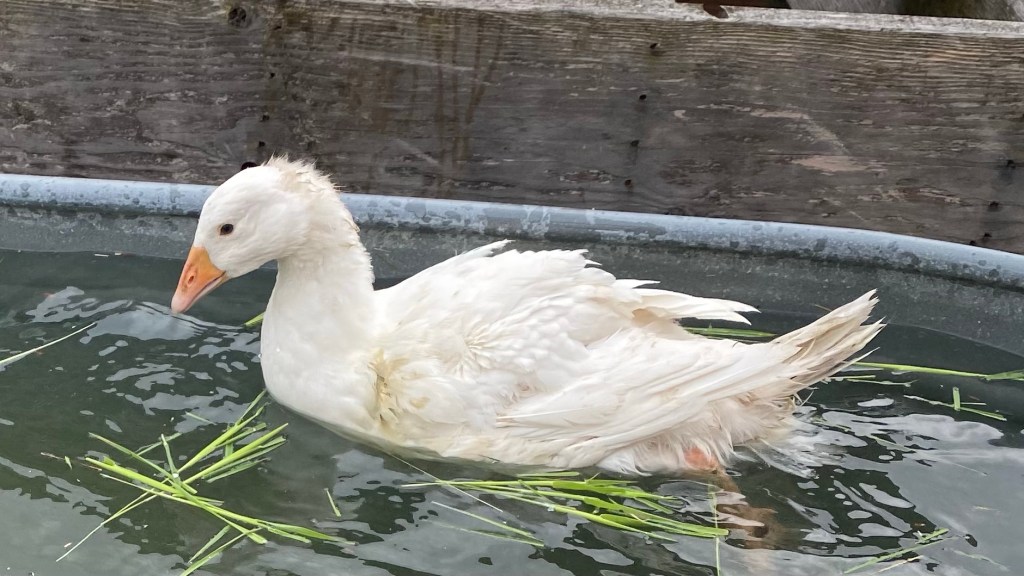
The same gosling was lethargic and barely eating a few weeks earlier. She had her neck drawn back and I thought she might be injured. In response, I moved all the goslings into a room with a heat lamp at night, as I had removed their heat source when they reached the size of an adult duck. The heat lamp did the trick and her appetite returned; I kept the goslings outside during the day and inside with heat at night, as well as when I was away from home and didn’t want to worry about predators. Eagles can be a problem during the day, as can the adult geese.
Sometimes a bird becomes lame in the absence of any injury, and you have a mystery to solve. I’ve concluded that in my flock, this is usually caused by botulism. A bird that ingests botulinum bacteria or the toxin they produce becomes progressively paralyzed and may eventually die from respiratory failure or other organs shutting down. The toxin is not metabolized quickly and the bird’s condition can worsen over a period of weeks, even when it is no longer exposed to the bacteria. As for where the bacteria are found, it could be in the soil, the bedding, or a dead rat somewhere in the birds’ habitat. Maggots are common transmitters. Regardless of how the toxin finds its way into your bird, you need to get it out. I’m having excellent results with activated charcoal.
I simply mix small grain activated carbon into the affected bird’s feed; biochar can also be used. The structure of the carbon causes it to absorb toxins, which can then be excreted. At the moment I have a cockerel that was unable to walk or stand, and I now have him on his feet and walking again, albeit a bit clumsily. I caught the condition early, when he could still walk, but was increasingly lethargic and uncoordinated; in spite of the treatment, the bird still became paralyzed, but did not progress to the point of being unable to eat and drink. After a few weeks of treatment, he is now being kept with some other young birds to help encourage his continued rehab. I expect full mobility within the next two weeks.
(Activated charcoal seems to also be helpful for birds being treated for sour crop, which is a yeast infection in the crop; some sources recommend OTC vaginal yeast infection meds, which I expect would work well, but I have not used them.)
One of the most common causes of lameness is bumblefoot — a condition you’ll find a lot of information about online. Bumblefoot occurs when a bird gets a small cut or puncture on its foot, which then becomes infected. A kernel forms in a pocket beneath the skin, causing the foot to swell and creating a lot of pain for the bird. Some online sources will suggest that you perform amateur surgery to remove the kernel; this is to be done without anesthesia. I do not condone this practice. I have never lost a bird to bumblefoot, but I have had quite a few cases of it, and ample opportunity to observe the condition’s progression. If you give it time, the kernel removes itself — the swollen area eventually ruptures and one or more hard, black masses begin to work their way out over several weeks’ time. If I can, I pull them out at this point, but if the infection is minimal I might just leave it alone. In extreme cases this process can take up to a couple years, but consider the alternative — a painful surgery you could easily botch, severing a tendon, for example, and an open wound that has to be dressed and cleaned, with no guarantee that the surgery itself won’t just cause more bumblefoot. It only takes a speck of a foreign body in the wound to cause it.
As with any ailment, prevention is the best medicine, although keeping chickens and turkeys from getting small cuts on their feet is nearly impossible, due to their natural scratching and digging and their propensity for perching in trees. Instead, I try not to breed birds that seem particularly susceptible to it. In my flock, the condition occurs mainly with roosters and tom turkeys, although I’ve also seen it in Guinea hens and in ducks. I usually separate the bumblefoot birds from the rest of the flock so that their limping and hopping on one leg doesn’t cause them to be picked on.
If healing the sick and the lame impresses you, you’ll really love how I raise chickens from the dead. Chicken Jesus, remember? It all started a few years ago when one of my roosters drowned in a water trough. OK, he wasn’t really dead; fans of The Princess Bride will be familiar with his actual condition. I placed his stiff body under a heat lamp and watched him come back to life over the next few hours. This particular rooster required some massage, as his muscles were cramping, but by the next morning he had fully recovered. I have done the same trick with a few more roosters and cockerels since — why it seems to always be male birds is a mystery to me. I position a board or a branch in the water troughs to give the birds a means of escape, but accidents do happen on occasion, especially when your yard pig pulls the boards out of the water.
If you’re using heat lamps, I recommend keeping a good thermometer handy to be sure the bird you’re reviving doesn’t cook. I like a hot spot between 90 and 100° F, usually closer to 100, but never more than that. Too cool and the bird may not recover quickly enough; the longer it’s cold, the less likely it is to pull through. I also make sure the bird can get away from the heat source when it’s ready, and I leave some food and water within reach. A bird that’s active, eating and drinking is ready to rejoin the flock, and you might be amazed at how quickly it happens. I haven’t documented the process from start to finish, but the little Sebright cockerel in the video below was a stiff corpse just a couple hours earlier.
The younger the bird, the easier it is to revive it. I’ve found day-old chicks out of their nests, stone dead, and warmed them up in my hands in just a few minutes. Recently I’ve had a very strange string of ‘mostly deaths’ in a group of black copper Marans chicks; for about two weeks, I found one or two chicks nearly every day that appeared to be dead. The chicks had appropriate heat and plenty of food and water. I never determined the cause of their ailment, but when I picked up the birds they were still slightly alive. I tube-fed them a small amount of parrot hand-feeding formula and placed them next to a radiator heater, and all of them fully recovered in 12-24 hours. If I felt food in the birds’ crops, which happened a few times, I skipped the tube-feeding; I also mixed a little corn syrup into the sick birds’ drinking water to boost their blood glucose.
If you raise pigeons, hand-feeding is a must-have skill. I have to hand-feed at least one in ten babies, especially those that leave the nest too early and get scalped. (Google it.) I’ve managed to pull some horrifically injured squabs through with tube-feeding and a little Neosporin — my most recent patient had its entire scalp peeled back with skull exposed, and now has only a small bald spot that I expect to disappear over the next month or so. Birds are simultaneously fragile and resilient. If you are raising both pigeons and chickens, it’s important to note that a squab has a much, much larger crop than a baby chick the same size; think ping pong ball vs. peanut M&M. If you overfeed a chick, the hand-feeding formula can get into the glottis and kill the bird. Raising a hypothermic bird from the dead is one thing, but one that has aspirated food into its lungs is a somewhat more difficult matter. Even Chicken Jesus has his limits.
I’m not a vet and I can’t tell you how to treat every ailment, but I can tell you what has worked for me. If you’re raising poultry and wondering what’s effective and what’s a waste of time, I hope this post helps. Thus sayeth the Chicken Jesus. Amen.
 year 45