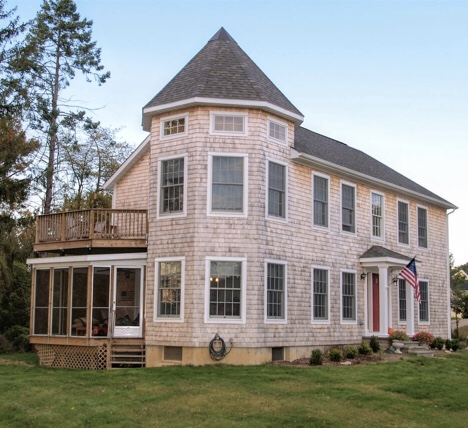
People often mix up manufactured and modular homes, and it doesn’t help that a lot of literature groups them together, using terms like “mobile-modular.” Modular homes are about as similar to manufactured homes as a desktop computer is to a laptop. In fact, I’m pretty proud of that analogy. Both are computers. Both are technically portable. One, however, is meant to be set up in one place, have its various components connected (computer, monitor, keyboard, mouse), and stay there, while the other is intended to be carried around a bit more. Modular homes are built in pieces, transported to the home site, and assembled; most of the work is done before the final assembly, so on-site build time is very short. There are a number of different systems around for this type of home, so what I say here is going to be fairly general, and won’t cover every option out there. For these purposes, the homes I’m talking about are made primarily from wood; there are other modular systems that I’ll discuss separately.
Author: steve
Portable Housing: Manufactured Homes
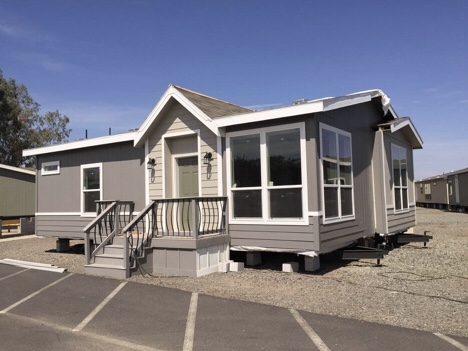
I may hate old mobile homes, but newer manufactured homes have a lot going for them. They’re better made, using better materials. They look better; in fact, many are indistinguishable from site-built homes, and if you remove the wheels and the tongue and bolt them to a foundation, they appreciate in value just like any other house. One of the biggest benefits of manufactured homes is their size; you can go big. In fact, there are triple-wides with 3,400 square foot floor plans — that’s about the size of my current workshop and barn. Of course, you don’t have to go that big.
Portable Housing: Mobile Homes
Depending on when it was built, when someone says ‘mobile home’, that could mean an actual mobile home or what’s now called a manufactured home, and there are differences. For the sake of simplicity, American mobile homes were made before about 1976, and were not subject to the same regulations as the manufactured homes that came after that. It should be noted, however, that the federal code regulating manufactured home construction has been updated from time to time, and in general, the newer the home, the more strictly its original construction was regulated. A home from 1980 might not have ever been of sufficient quality to pass a new home inspection in 2010. But for the purposes of this entry, that doesn’t matter, because we’re talking about mobile homes — the old, crappy ones. Continue reading
Portable Housing
This series of articles was originally going to be one, single entry, but it got pretty long and as I wrote, I continued to do more research, and it became the sort of piece that I might never finish. I took a break for the election and subsequent bullshit, but now I’m back at it.
This is about portable housing. If you know me, and you don’t, you know that I’ve lived in a lot of different types of homes, most of them very non-traditional. I won’t list them all here, because I feel like I might have already done that elsewhere on this site, but where I have personal experience I’ll try to include some of it. If I was writing about this subject generally, I might have different things to say about each type of home, but I’m writing about them as options for a very specific scenario — moving to a rural property in the tropics, setting up housing quickly and efficiently, and living in it for an underdetermined period of time while I build outbuildings and more permanent human housing. Continue reading
Ah, rats!
I pulled a bunch of images off the Internet for this entry. This is an educational entry so I’m considering the use of these images to be educational fair use. I’m not selling them or making any money from them, or anything else on this site. If you own one of these images and want me to take it down, let me know. Moving on …
I have a rat problem. Continue reading
Animal transport: in-country and abroad
There are a lot of different ways to move animals. When I make my move inside the US, I’ll be hauling them in a trailer and/or inside vehicles. I’ve done a lot of animal transport that way and had very few issues, even in the middle of the summer. The main advantages to doing it this way are cost and being in complete control of the process — when you transport animals at a professional level, which I do, entrusting responsibility to strangers, regardless of their credentials, does not make for a very pleasant emotional experience. The drawbacks to overland transport are how long it takes and the variables you encounter along the way, and you’d better not break down. I’ve driven through blizzards, heat waves and tropical storms on the same transport, and on everything from city streets to mountain roads. It can be hard on the driver and even harder on the animals. Depending on what kind of animals you’re hauling, it’s often best to have two or three drivers and just power through it, but with horses and other animals that travel standing up, you do the opposite unless you can get from A to B in one driver’s shift.
Here, I’ll discuss some of the other ways to move animals around, some pretty standard and some a bit more ‘out of the box’ — not my favorite phrase ever since thinking outside the box became such an inside the box exercise. Moving on… Continue reading
Here it comes
I’ve got to be honest— I’m not ready for another Pacific Northwest winter. I had hoped I’d be moving this month, but thanks mostly to COVID-19, things haven’t been unfolding quite like I’d hoped. So here comes the rain, and I don’t feel like being cold and wet.
October would have been the ideal time for a Texas move. All the birds are done breeding for the year, even the pigeons. (I took their calcium away.) The day length is now pretty similar here to what it is there, so that won’t mess with the birds’ biorhythms. That said, it’s still pretty hot in Texas right now. Maybe I’ll pull off a miracle and get out of here in late winter or early spring, before the geese and turkeys start laying eggs, and when temperatures in the Northwest and in Texas are as close as they ever get.
Moving from Texas to the tropics, there’s a little less to worry about where the weather and the length of the day are concerned. Where I would avoid a summer move from the cool Northwest to the hot South/Southwest, a place like Panama is going to always be about 85 to 90 degrees F, so only a midwinter move from Texas would present any kind of difficult temperature adjustment for the animals. Moving in the middle of summer would even be a welcome change, with about a ten degree temperature drop. And in terms of day length, Panama has roughly an hour difference between its longest and shortest day, and it’s never more than about an hour and a half off from Texas. Of course, it’s been my plan to take mainly eggs to Panama, rather than a large shipment of live birds, rendering differences in temperature and photoperiod moot.
Containerization and the Portable Farm
Awhile back I did a sort of thought experiment; I tried to figure out how to make a ranching and forestry operation totally portable, such that a camp could be broken down and moved in just a few days. The idea was to move onto a property, partially log it, graze it, and develop it into a campground, a housing development, or whatever the property was best suited for, and then move on. I figured out most of the details on how to do it, using RVs, shipping containers, semi trailers, and tents. I even invented a 24×40’ barn that compresses down to eight feet wide for transport, and can be set up or taken down in just a few minutes. Continue reading
The hard way
One thing people invariably ask is why I would attempt to move abroad with a ton of animals, and it’s a fair question. The simple answer is that when I get there, I want to have a ton of animals, and the places I’m looking at moving to don’t have the same diversity of livestock breeds that we have in the US (or in Europe, for that matter). So if I’m going to have to import animals anyway, why not import the ones I already have?
The more complicated answer is that in the case of my pets, I have a responsibility to them, which includes not dumping them when they become inconvenient. And in the case of my poultry, while I also have a responsibility there, they are much easier to find suitable homes for than my dogs, however, I would be throwing away all the genetics work I’ve already done and starting over.
The good news is that there are a lot of different ways to move a large number of animals to another country if you’re willing to take your time and do it right. Another piece of good news is that when it comes to all of my birds except my pigeons, I don’t have to deal with the import/export process at all — I can simply take eggs. If something goes wrong and I lose a bunch of hatching eggs, it’s not the end of the world and I can just have my birds back in the States lay more.
I recently scored a top of the line incubator on eBay for a fraction of its actual value. Google Grumbach incubators if you’re curious. I won’t be able to hatch a thousand eggs at a time, but I can do 80 or so, and that’s not bad. And between now and then I may manage to get another incubator or two.
Unless I want to hand raise pigeons, and I’d really rather not, they’re a little bit different story, since baby pigeons can’t feed themselves. So pigeons will have to be transported. Fortunately you can typically do that on any commercial flight, so long as your paperwork is in order. I would almost certainly sell off my surplus pigeons prior to the move, and probably make enough to pay for the transport of the remaining birds. That’s assuming I don’t just put all my animals on one big cargo jet. You know, with all the millions of dollars I’ll magically have…
So that’s the gist of it. If all I wanted was to lie around on a beach for the rest of my days, I’d already be doing it. But I’m looking to do something more complicated, and that means a more complicated, and expensive, move.
Why Texas?
I’ve realized that when I last posted to this site I was not fully committed to moving to Texas, and some things have changed. I now have as my short term goal a move to central or southern Texas, and here’s why:
1. I’m not financially or logistically ready to move abroad yet. While that remains my ultimate goal, making that move with animals and equipment is complicated and requires an intermediate step. I want to move to Panama, though I haven’t ruled out Mexico; in either case, getting to Texas and having a ranch there from whence to stage the move, slowly and deliberately, would be a major benefit. And yeah — I just said whence.
2. I don’t want to wait to ramp up my agroforestry efforts. I’m not getting any younger, and there’s a scenario where I’m in my 50s or even my 60s by the time I get to where I really want to be living and working — I don’t want to sit around doing nothing in the meantime. I can raise animals and grow trees and do research in Texas.
3. Texas has a lot to offer. There are multiple international airports within a few hours of each other (Dallas, Houston, Austin, San Antonio) and that means more competitive pricing for international and domestic flights. Overall, flights to and from Texas are the cheapest I’ve found anywhere. And it’s a quick drive to Mexico, and a day’s drive or less to almost anyplace in the contiguous US. There are a lot of excellent schools in Texas, including a great veterinary school (A&M); good schools mean good interns. Texas is livestock central, but it’s also close to other states that are good sources for livestock. Texas has some of the best hospitals in the country. Austin is a tech hub. Houston is one of America’s largest ports, and there is a massive railroad infrastructure, including trains that cross the border. Texas has a better business tax system than a lot of states, as well, and some very favorable property tax cuts for agricultural land. Texas has so much going for it, you can almost look past how god damn hot it gets there. Almost.
4. Texas is getting bluer by the day. I’ve made no secret of my political affiliation, but I also don’t love living in a place where my vote doesn’t carry much weight. I’d rather be in a battleground state for a lot of reasons, not just to make a bigger difference with my vote, but also because when my party runs everything they can get a little carried away. It’s good to have some pushback, something I especially feel as a gun-owning Democrat.
Having said all that, Texas is a big place, and each region is pretty different from the others. I’ve spent a lot of time researching and mapping the state; I can show you where all the oil and gas wells are, every tornado path, where the hail is especially bad, where the ground water is and how deep the wells are, the soil types, rainfall, average temperatures, and so on. Considering all the data, the conclusion I’ve come to is that the area between Austin and San Antonio (San Marcos, Lockhart, etc.) is ideal. Unfortunately a lot of other people agree, and it’s some of the most expensive real estate in Texas. I don’t want to be too close to the coast (hurricanes), too far west (desert), or too far north (tornados, hail, Republicans), but I think I could be happy in most of central or south Texas.
If you’re reading this and thinking, ‘I want to buy this guy a ranch,’ here’s what I’m looking for, besides the location:
1. Property size: as large as possible. For free range poultry, 35 acres or more would be ideal, but that doesn’t allow for much in the way of additional animals of the hoofed variety. I’ve seen some places over 100 acres that are in my price range (but if you’re a generous, wealthy person trying to buy me a ranch you don’t really care about my budget…)
2. Homes: the main house needs to be big enough for a family with five kids. Three bedrooms/two bathrooms are the absolute minimum, since I can always add on, but a bigger house would be better (just not a mansion — the people who will be renting it prefer a smaller house). The second home should be two bedrooms/one bathroom minimum, but I could also work with an RV or mobile home hookup. I’ve also looked into getting a vacant parcel and developing it myself, and I’m not opposed to it, but the main issue there is financing both the purchase and the improvements.
3. Outbuildings: I need at minimum a barn and a workshop, but the more the better. I will inevitably need multiple barns, and having a garage or at least covered parking would be great.
4. Water: there must be surface water of some kind, or at least the ability to build ponds and have them functional for ducks and geese fairly quickly.
5. Fencing: it’s expensive, and having some already on the property would be great. A lot of larger properties in Texas have exotic animals on them and are fenced; that’s kind of a mixed bag, as I don’t have any interest in trophy hunting or running a hunting ranch, but I also don’t believe those animals belong in North America and I do eat meat…
6. Minerals: I don’t want any drilling on the property. I don’t care if I have mineral rights, so long as there are no minerals to have rights to. I don’t want trucks coming in and out, I don’t want oil spills, I don’t want fires, and I don’t want my groundwater or surface water polluted. Hopefully that sounds reasonable.
7. Since you’re buying, why not a pool? It’s not so much for me as for the renters. I mean, it’s really hot there, and kids like to swim.
8. Income: if the property has housing for guests, workers, or long-term renters, or a place for storage rentals, that would be excellent.
In a later post I’ll talk about some of the things I want to do on a Texas ranch and how I want to stage a move abroad from there.
It’s been awhile
I’m not cut out for blogging. I get wrapped up in life and stop writing about it, but I’m still here, still working on poultry genetics, still frustrated that I can’t travel, still putting a plan together to get out of here and onto a tropical farm.
In the meantime, the president of the United States is trying to kill himself and take as many people down with him as possible, my cell service is getting worse by the day (thanks, Verizon), I’m drawing unemployment for the first time in my life (thanks, Covid), the claims website is so overloaded I’m lucky if I can submit my weekly claim at all, and when I do finally manage to get through the process without the page crashing, I’m a week behind schedule, and oh— I have a huge rat problem. So, uh… interesting times we’re living in, I guess.
I’m not trying to complain. The truth is I have it better than many people right now, maybe even most people. And I’m more or less healthy; these days that should be the headline, not the afterthought. But I do feel we should all get to subtract one year from our ages and give 2020 a do-over. Plus that would mean I get to go to Panama again, right?
Here’s a partial list of what I’ve accomplished toward my goal since the last time I posted:
1. I have a shipping container and am in the process of moving my tools and some other belongings into it. When it’s moving time it just has to go into a trailer and I’m off. I do not have the trailer yet, but I’m working on it. Having the tools and other stuff out of the shop will also allow me to clean the shop up. (I’ll write more about how shipping containers figure into my larger plans at a later time.)
2. I’ve put the word out that I want to sell my property. I had been hoping to keep it, but I realized that was holding me back, so I’m working on selling it. I owe very little on it now so a sale would mean enough for a big down payment on a ranch and plenty of moving budget.
3. I’ve been paying down my credit cards. I haven’t been super good about it, but I’m getting there. Depending on what happens with the next stimulus, I should be in a place where my only debt is my student loan, and we’ll just not talk about how much that is.
4. I’ve been getting my vehicles in better shape to move. My van is at about 90%; my truck needs more work, but I’ve made major progress and the main things I need are a good body person to tighten up all the panels I’ve replaced, and a good HVAC person to fix that system, since the local hacks have failed to do so multiple times.
4. I bought a car dolly so if my Camry doesn’t get fixed by moving time I can tow it easily.
5. I’ve added some new breeds to my poultry. That doesn’t have anything to do with moving but it does get me closer to my future goals with regard to poultry breeding, and it doesn’t change anything for the move. In chickens, I’ve added Sicilian buttercup, Penedesenca, and Appenzeller Spitzhauben. In pigeons I’ve added Texan pioneers and American giant homers. I’ve also had some successful Narragansett turkey, Ayam Cemani, and Muscovy duck breedings. If this is all nonsense words to you, that’s understandable, but to me it’s pretty exciting stuff.
6. This one’s big — I have a partner of sorts. Basically, if I move to Texas and am able to get a property with two homes on it, or one home and an RV hookup, I have a family that will move with me, rent the larger home from me, and share in some of the farm chores. Obviously nothing’s a done deal until a lease is signed and there’s money in the bank, but if things work out on that front it will essentially ensure that my mortgage is paid and I can travel some, assuming Covid goes away at some point and Americans are welcome abroad again. If the arrangement falls through I’ll look for someone else to rent from me.
Anyway, I’m going to give this thing another go, and try to write a little more about the things I started this blog to write about. First thing will be to re-read everything and see what I already said. For now, I’m losing my train of thought, so I’ll sign off.
Paper Tiger King
I hate that I’m writing about this.
Netflix really wants me to watch Tiger King. With a stay home order in full effect, there’s not much left on Netflix that I want to watch and haven’t seen yet. I feel like if I haven’t watched Tiger King by now, it’s pretty unlikely that I’m going to. You’d think that after suggesting it to me about fifty times and having me pass every single time, the algorithm would take the hint, but the Netflix algorithm, for all its purported sophistication, is a blunt instrument.
It’s not the first time the algorithm has offended me. For one thing, it seems to think I speak every human language fluently, as it constantly suggests foreign films and TV shows. I like foreign films, but I also like to multitask, and that’s hard to do if I have to read subtitles. And there was that time when I watched one standup special and Netflix spent the next year trying to get me to watch the racist ventriloquism of Jeff Dunham. I watch one British comedy and suddenly it’s all tea and crumpets and ‘ello guv’na. I watched Six Feet Under and for the next two years the algorithm assumed I was gay. It has no sense of moderation or subtlety. It doesn’t get that when I watch one DIY show, that doesn’t mean I want to watch every DIY show, or only DIY shows. Even worse, when new episodes come out of something I actually do watch, the algorithm is so busy pushing shit on me that I don’t want to see, it doesn’t bother to let me know. And I get it — First World problems, but that doesn’t mean it isn’t seriously annoying.
Still, none of it sticks in my craw quite like Tiger King. Continue reading
 year 45